
Microsoft D365 Human Resources is as the name suggests Microsoft’s human resource management solution (HRMS) also often referred to as a HCM solution (Human capital management).
After a brief outing as a standalone product that could be optionally integrated into the wider suite of D365 Finance & Operations functionality, it is now sensibly ‘nested’ back within the Dynamics 365 suite of modules.
AX Software have long been recognised as specialists providers of Human Resource consultancy, supplying consultants directly to end user clients as well as the wider Microsoft Partner network since 2006.
With extensive experience of some of the most high profile and complex deployments there have been to date of HR, AX Software have been involved on both client and partner side implementations helping them leverage the most out of Microsoft D365 HR’s capabilities, improving business processes and efficiencies along the way.
Microsoft’s Continued Investment in HR
Continued investment in Microsoft D365 Human Resources functionality demonstrates the importance they place on this once over looked area of Dynamics.
As most employers will state it’s all about your employees and workers and we are seeing consistent, incremental improvements to D365 HR as a result.
This continual improvement has removed much of what was a historical requirement to have to develop several weaker areas of functionality within Dynamics HR, as sophisticated capabilities have now become standard features of the product.
People familiar with older versions of Microsoft Dynamics Human Resources are always pleasantly surprised to see just how far D365 has come and of how configurable new functionality is with many lessons learnt by Microsoft in terms of an extremely high level of user flexibility when it comes to configuration and not having to rely on development.
Additionally tools such as MS Form’s, Personalisation’s and Power App’s have added new ways of enhancing the standard behaviour of D365, without going down the coded development route.
They offer flexibility and free users of potential reliance on their Microsoft Partner company but where development is still a necessity it is still available.
The message to take away is that the user can be empowered with tools that are becoming ever more user friendly and the easier Microsoft make these tools to use will result in efficiencies, self efficiency and overall lower costs to your business.
HR Evolution
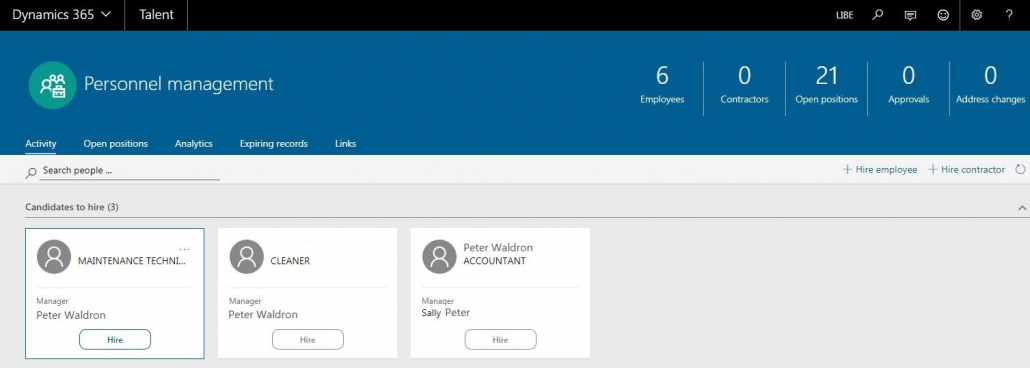
Microsoft Dynamics D365 Human Resources built upon the functionality available within AX2012 and later Dynamics Talent before sensibly coming back to nest again in Dynamics D365 suite of modules.
Taking what were some solid foundations from its previous incarnations the capabilities and functionality have progressed so significantly in recent years and now with the advent of Copilot we are seeing really useful functionality that was once really nothing than speculation and a roadmap with a very long road ahead of it!
Absence Management
With absence types, plans and entitlements, carry overs in hours and/or days this type of functionality significantly enhances what used to rely on an ISV bolt on application or alternatively heavy development.
Absence entitlement plans can be defined in hours or days, hours being particularly important to organisations that have part time working patterns. Recent enhancements allow you to specify against the absence type and have different rules in different geographical regions. At last Microsoft have something here that we can say meets the requirements of virtually every sector we have encountered.
This functionality also extends to the definition of the job and position an employee occupies with FTE being a factor that will accrue entitlements based on what the FTE equivalent factor is set at i.e. a worker with an FTE of 0.5 will accrue only half of the entitlement of a worker with a FTE of 1.0.
This kind of flexibility allows you to configure a minimal number of absence entitlement plans, an important consideration should always be the on-going maintenance effort associated with having too much differing configuration (someone has to administer it!)
Checklists & Tasks
Creating Checklists with your own definitions of Tasks is a great way to identify what needs be done, when and by whom whenever a worker on-boards, transitions to another position or company or off-boards an organisation.
Think of it as a simplistic workflow but without the technical overhead often associated with defining rules and conditions and you have a tool here that can be used to great effect within your HR department as well as your employee self service portal.
With the ability to detail exactly what needs to be done, with prompts of outstanding activities and tasks it is used to inform and track the progress of important tasks within your organisation. Users get to see what’s assigned to them and with administrator views you can centrally monitor that the wider organisation is adhering to the activities that need to be followed that ultimately provides you with accurate employee data as well as those efficiencies that prompt action brings i.e. I forgot becomes a redundant argument when its a prompt on your screen!
Checklists and Tasks offer a very efficient means of configuring Microsoft D365 Human Resources without actually going as far as creating workflows. Workflows can create anxiety amongst infrequent users whereas Checklists and Tasks offer a very simple to understand and configure tool that the HR team in our experience immediately feel comfortable with.
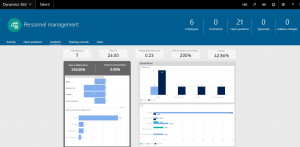
D365 Analytics
Most features within Microsoft D365 Human Resources have their own comprehensive and predefined list of Analytics reports that graphically display the information within the module you are in.
These out of the box analytical reports are designed around the functionality you configure in Dynamics, with sorts, filters and tools that allow them to be visually rendered on the form or easily exported etc.
These greatly improve the look and feel of the product and remove what used to be a significant reporting configuration effort with associated costs.
It is fair to say that in our experience clients always want more and this is were a BI reporting approach can enhance what is already on offer we find that there is never enough OOB variation and capability to satisfy everyone but Dynamics HR certainly provides users with a comprehensive start.
BI is also one of those specialised areas of expertise that we have within AX Software having a skills we often provide to other Microsoft Partner companies particularly around the Human Resources structure which is not so widely understood within the partner community.