D365 HR or standalone HRM Solution?
We often get asked why we think an organisation should use D365’s HR functionality rather than a stand alone HRM / HCM solution which could be interfaced to Dynamics 365.
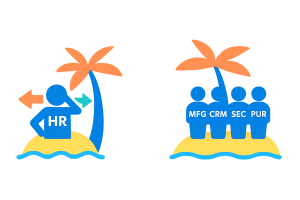
Creating data islands is always going to create isolation from other systems and creates a divide between people – in a way it seems counterintuitive to the concept of Human Capital Management to have systems split out by such an approach.
Choosing whether a D365 HR or Standalone HCM is right for your business needs to consider some of the points we have identified below.
Familiarity
The rest of the business will be familiar with Dynamics D365 using it on a daily basis to run the organisation, a different method of navigation, look and feel, two sources of information and productivity tools that differ per workstream will cause confusion in your work force. ‘Them’ and ‘Us’ attitudes are highly likely to develop which in a single workplace is not healthy.
Workflow
Workflow is one of the most important productivity tools within modern systems, many work flow activities follow reporting hierarchies and to be up to date and accurate these hierarchies would need to be replicated in both systems if making a D365 HR or Standalone HCM choice.
Developing functionality or creating an interface to link two systems is complex (trust us, we have attempted it and are not ashamed to say regretted the effort). Its expensive and typically not that robust, simply trying to maintain records manually as an alternative is prone to error, admin heavy, .and a thankless task for the poor person doing it!
Microsoft themselves with their huge investment resources created their own standalone HCM solution marketed as Microsoft Talent. It had many new features and functions and was intended to compete in its own right as a HCM product independently of Dynamics 365 F&O. For customers who wanted to an all Microsoft solution, a sophisticated integration toolset was provided.
However even with all of Microsoft’s resources it never quite lived up to the seamless integration promises envisioned and they sensibly brought HR back into D365 as suite of HR modules.
The moral here is not if Microsoft struggled to get it right is it something sensible for a business to attempt integrating two products if they do not have to?
Technical Ability
As work flows often need logic and are semi-technical in nature, the HR department will need their own administrator/expert as they would not be able to rely on support from the rest of the business who will have their own system to manage.
‘That Lot in HR’
If you do have your own solution its almost inevitable that you will be treated as ‘that lot in HR’ whenever there’s a difference or issue between the core business system and a separate HR solution, it’s human nature and a trait that professional HR personnel will recognise whenever there’s different working practises in play.
The wider business will never be as dynamically aware of the situation with regards to employees when two separate systems are involved. Creating interfaces to help alleviate this can be expensive and impractical as many might be required and trust in systems does not take long too break down as information silo’s form on either side.
Everyone pulls together better when all in the same boat and that’s why a fully integrated business solution incorporating HR and all your ERP processes really is the most efficient way of working together.
Duckling to Swan
D365 HR functionality may not win a beauty parade when standing next to some of the well known HR stand alone systems straight out of the box but you have look at the wider picture and beyond the first impression.
Remember the tools that Microsoft provide, allow you to tune the view to what’s important to your business, Microsoft’s view is good but its not the end.
The complexity, cost and ongoing management of integrating systems should never be underestimated, opting for a fully integrated business solution from the outset, then using Microsoft’s powerful tools to beautify what your employee’s see will offer you the most cost effective HR system in the longer term.
Making that D365 HR or Standalone HCM decision based on looks alone is a flawed strategy when Microsoft have tools available to configure your fully integrated D365 as appropriate during the build phase of an implementation.
Additional Effort
Everything can be doubled up when implementing separate systems, data migration, configuration, training, maintenance, documentation, support, reporting – all need separate resources to perform these activities and cost will rapidly escalate.
A D365 HR or standalone HRM Solution decision would have huge consequences on effort if the latter option was adopted within a business.