
Dynamics 365
Microsoft Dynamics D365 Finance Operations (Microsoft Dynamics or D365 for short) is the latest cloud based version of Microsoft’s flagship ERP offering.
Dynamics D365 is a global product with global multisite capabilities, with a familiar look and feel and is what we have based our Dynamics business consultancy on for the past 20 years.
Component Based
Microsoft Dynamics D365 is a component based solution which allows companies to select and configure the functionality they require which matches or enhances their business processes.
Features can be turned on mostly by flags that activate additional content ready for build and configuration.
With D365 been a cloud based product, new features categorised by module, automatically appear as options that can be activated once they have been released by Microsoft in line with their strategy of continuous development which can be seen in their Roadmap.
Gone are the days where it had to be a full scale migration to another version of the software or a completely new ERP system, this is one of the key success features of Dynamics and of a modern approach to implementing and maintaining an ERP system.
These new features will still need to be tested in line with an appropriate deployment methodology but the message here is that Microsoft Dynamics D365 does not stay still and stagnate.
Similarly to Microsoft’s other technologies which have dominated the back office workspace for decades, a strategy of continuous D365 development will keep your business aligned with the latest in best practise and competitive in a quickly evolving business world.

Tiered Levels of Functionality
Each component of D365 typically has tiered levels of functionality, which allows organisations small or large, with simple or sophisticated requirements to configure and deploy the right level of functionality for them.
If full warehouse management is a requirement of your business that functional element can be configured for use. If however you business has a more basic stock management requirement without the need for example of complex picking rules with replenishment areas etc. a lower level of capability can be configured and deployed.
This is an important factor, not only does D365 offer alternative ways of operating within a single business solution, it also future proofs the business for change, whilst at the same time does not require you to deploy unnecessary functionality that has a configuration/effort/cost associated to it.
To a business keen to deploy their shiny new ERP system, its important to get the right guidance and only deploy what is necessary and this is where its almost as important making the right choice of implementation partner. You may hear the term minimum viable product (MVP) which is an approach to deploy only what the business requires, its the most cost effective way of implementing an ERP business system and something we really believe in at AX Software.
This is where we, with our 20 years plus full life cycle implementations experience will bring benefits to your business.
Adaptability and Change
Should business requirements change as they invariably do, we know how best to approach these changes and deploy additional Microsoft Dynamics D365 FO functionality.
It is not just deploying new configuration but everything that goes with it from changes to process, data and training.to workflows that in modern ERP systems control so many of the authorisation and approval routines.
Been able to flex and adapt has been a main driver of D365’s success, it can adapt in line with your business or organisational needs.
It’s a platform that provides you with a long term solution that continually evolves in line with Microsoft’s other products with that familiar look and feel that help users quickly adopt to it as a business solution of choice.
Deploying changes to a live system is itself potentially complex, particularly with all the other products and tools that can hung off of a Dynamics 365 implementation. once again its the experience of your partner company here that can make that deployment go smoothly OR not.
Scalability
D365’s ability to scale up or down with your business is a principle followed by other Microsoft products, with this approach the cycle of periodic ERP review can become a thing of the past.
Microsoft’s commitment to continued development with periodically published roadmaps, provides businesses and organisations with assurance that their investment will stand the test of time.
It no longer has to be an expensive radical change reviewing and and moving to another business system every 10 years or so but incremental improvement over time. With Microsoft can you imagine trying to write a business case for swapping out your back office products? This is basically the same it should be with your core ERP system.
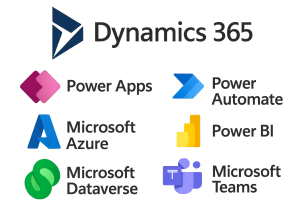
Microsoft’s long term strategy with Dynamics D365 sees ever closer integration with a whole suite of other Microsoft products and technologies.
With the advent of AI and Copilot, business software is seeing a surge in capabilities probably not seen since workflows became a feature of D365, it is an exciting time for ERP and an opportunity for business to gain some real efficiencies in so many of their enterprises processes.
If you are not looking seriously at Dynamics 365 F&O as a solution for your business, are you been serious about ERP?
Technology Integration
Microsoft’s long term strategy with Dynamics D365 sees ever closer integration with a whole suite of other Microsoft products and technologies.
With the advent of AI and Copilot, business software is seeing a surge in capabilities probably not seen since workflows became a feature of D365.
It is an exciting time for ERP and an opportunity for business to gain real efficiencies, automating processes, real time notifications and approvals.

Microsoft’s Roadmap for D365
The Microsoft Dynamics 365 development roadmap focuses on integrating AI, automation, and user experience improvements. This is achieved through a “release wave” system that introduces new features twice a year.
These features reveal themselves within the Features menu of D365, as a cloud based system they automatically appear but importantly do not activate unless you choose to deploy them. This should always be done under the guidance of your Microsoft Partner or in a test environment if you are already operating a live Dynamics environment.
Key areas of development include expanding Copilot capabilities across various Dynamics 365 and Power Platform products, enhancing agent and supervisor tools, and focusing on core functionality improvements for modules like Sales, Customer Service, and Field Service.
The latest updates, detailed in the 2025 release wave plans, emphasize AI-driven automation, seamless integration with Microsoft 365, and better performance
If you are not looking seriously at Dynamics 365 F&O as a solution for your business, are you been serious about ERP?