
Microsoft D365 Human Resources
Microsoft D365 Human Resources is, as the name suggests, Microsoft’s Human Resource Management Solution (HRMS), often also referred to as a Human Capital Management (HCM) system. After a brief period as a standalone product that could be optionally integrated into the wider Dynamics 365 Finance & Operations suite, it has now — sensibly — been fully nested back within the core Dynamics 365 modules.
AX Software has long been recognised as a specialist provider of Human Resource consultancy, supplying HR consultants directly to end‑user organisations as well as to the wider Microsoft Partner network since 2006. With extensive experience across some of the most high‑profile and complex Dynamics HR deployments, we have helped many organisations navigate and maximise the capabilities of Microsoft D365 HR.
Where functional requirements exceed standard capability, our practical, common‑sense approach has overseen significant development in a cost‑effective manner. And whenever there is a better way to achieve the desired outcome, our deep knowledge of the Dynamics ecosystem allows us to recommend tried‑and‑tested vertical solutions. While some partners may prioritise their own interests, we firmly believe the right answer must always be the one that best serves the client.
This mature pragmatism — born from decades of experience — has also seen us support and manage the complex relationships that can develop between partners and clients. ERP implementations are expensive, high‑pressure undertakings, and tensions can arise. Our ability to arbitrate, steady the ship, and maintain productive working relationships is a key reason we have remained a trusted presence in the Dynamics ERP world for so many years.
Microsoft’s Continued Investment in HR
Ongoing Commitment to HR Innovation
Microsoft’s continued investment in Dynamics 365 Human Resources demonstrates the importance they now place on an area of the ERP suite that was once overlooked. As most employers will agree, success is driven by employees and workers — and Microsoft’s incremental improvements to D365 HR reflect this understanding.
From Gaps to Strengths
This steady enhancement of functionality has eliminated many of the historical gaps that previously required custom development. Capabilities that once needed bespoke solutions have now become standard features, reducing cost, complexity, and reliance on partner‑led development.
A Modern, Highly Configurable HR Experience
Users familiar with older versions of Microsoft Dynamics HR are often pleasantly surprised by how far D365 has evolved. New functionality is highly configurable, with Microsoft clearly applying lessons learned to deliver exceptional flexibility without forcing organisations into development-heavy approaches. Configuration, not coding, is now the default path.
Enhanced Tools Without Development Overhead
Tools such as Microsoft Forms, Personalisation, and Power Apps have introduced new ways to extend and enhance standard D365 behaviour without writing code. These tools empower HR teams to adapt processes, capture data, and refine user experiences independently of their Microsoft Partner — while still retaining the option for development when genuinely required.
Empowering Users and Reducing Costs
The key message is empowerment. As Microsoft continues to make these tools more intuitive and user‑friendly, organisations benefit from increased efficiency, greater self‑sufficiency, and lower overall operational costs. The more accessible Microsoft makes its HR tooling, the more value businesses can extract from Dynamics 365 without relying on expensive customisation.
HR Evolution
From AX2012 to Talent to Modern D365 HR
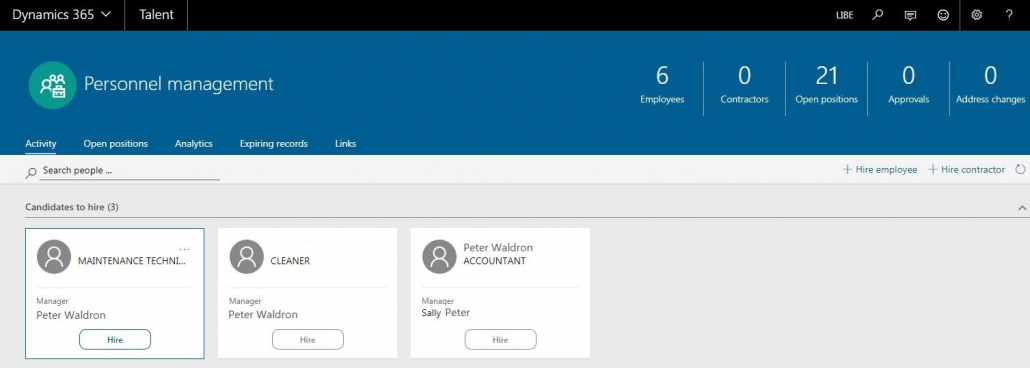
Microsoft Dynamics 365 Human Resources has evolved significantly over the years, building upon the foundations established in AX2012 and later in Dynamics Talent before sensibly returning to its place within the wider Dynamics 365 suite of modules. Each iteration has strengthened the product, transforming what were once solid but limited capabilities into a modern, highly configurable HR solution.
A Rapidly Advancing HR Platform
The progression in functionality in recent years has been substantial. Features that were once only speculative — sitting on long‑term roadmaps with uncertain delivery timelines — are now practical, usable components of the product. With the advent of Copilot, we are seeing genuinely valuable capabilities that previously felt like distant possibilities.
This evolution reflects Microsoft’s commitment to making HR a first‑class citizen within the Dynamics ecosystem. The pace of improvement, combined with intelligent automation and AI‑driven assistance, has taken D365 HR far beyond its earlier incarnations and positioned it as a forward‑looking HR platform capable of supporting modern workforce needs.
Absence Management
Modern, Flexible Absence Planning
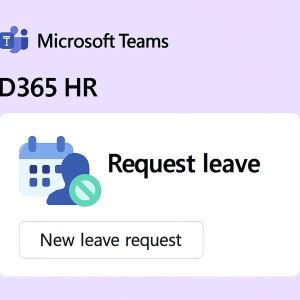
With absence types, plans, entitlements, and carry‑overs in both hours and days, Dynamics 365 now delivers functionality that previously required an ISV bolt‑on or heavy custom development. These capabilities significantly enhance what used to be one of the weaker areas of Dynamics HR.
Hours, Days, Regions, and Rules
Absence entitlement plans can be defined in hours or days — with hours being particularly important for organisations operating part‑time working patterns. Recent enhancements allow rules to be set at the absence‑type level and even vary by geographical region. At long last, Microsoft has delivered functionality that meets the requirements of virtually every sector we have worked with.
FTE‑Driven Entitlement Accrual
This capability extends into job and position definitions, where an employee’s FTE value directly influences entitlement accrual. For example, a worker with an FTE of 0.5 will accrue half the entitlement of a worker with an FTE of 1.0. This level of precision ensures entitlement calculations remain accurate and fair across diverse working patterns.
Smarter Configuration, Lower Maintenance
This flexibility allows organisations to configure a minimal number of entitlement plans rather than maintaining large volumes of slightly different configurations. Reducing configuration complexity is crucial — every additional plan requires ongoing administration, and someone ultimately has to maintain it.
Dynamics 365’s modern absence management tools strike the right balance between configurability and maintainability, giving HR teams the power they need without creating unnecessary long‑term overhead.
Checklists & Tasks
Simple, Effective Process Guidance
Creating checklists with your own definitions of tasks is an excellent way to ensure the right activities happen at the right time, carried out by the right people. Whether a worker is onboarding, transitioning to a new role or company, or offboarding entirely, Checklists & Tasks provide a clear, structured method for guiding these processes.
A Lightweight Alternative to Workflow
Think of Checklists & Tasks as a simplified form of workflow — without the technical overhead of defining rules, conditions, and logic. This makes them ideal for HR teams and employee self‑service portals, offering structure and accountability without the complexity that traditional workflows can introduce.
Visibility, Accountability, and Progress Tracking
With the ability to specify exactly what needs to be done and by whom, Checklists & Tasks provide prompts for outstanding activities and track progress across the organisation. Users can clearly see what has been assigned to them, while administrators gain central visibility to ensure required actions are being followed. This leads to more accurate employee data and eliminates the classic “I forgot” excuse — when a prompt appears on screen, accountability becomes unavoidable.
HR‑Friendly Configuration
Checklists & Tasks offer a highly efficient way to configure Microsoft D365 Human Resources without needing to build full workflows. Workflows can create anxiety for infrequent users, whereas Checklists & Tasks are simple to understand, easy to configure, and — in our experience — immediately embraced by HR teams. They strike the perfect balance between structure and usability.
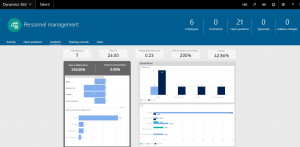
D365 Analytics
Rich, Predefined Analytics Across HR Modules
Most features within Microsoft D365 Human Resources come with comprehensive, predefined analytical reports that visually present the information held within each module. These out‑of‑the‑box analytics are designed around the functionality you configure, offering sorts, filters, and visual tools that can be rendered directly on the form or easily exported when needed.
Reducing Reporting Complexity and Cost
These embedded analytics significantly enhance the look and feel of the product and remove what used to be a major reporting configuration effort — along with the associated costs. What once required custom development or specialist ISV reporting tools is now available as standard, giving HR teams immediate insight without technical overhead.
When Clients Need More
It is fair to say that clients often want more than what comes out of the box, and this is where a BI reporting approach can elevate what Dynamics already provides. While OOB analytics offer a strong foundation, they rarely satisfy every organisation’s unique reporting needs. Dynamics HR gives users a comprehensive start, but BI tools unlock deeper, broader, and more customised insights.
Specialist BI Expertise at AX Software
Business Intelligence is one of AX Software’s specialist areas. Our expertise is frequently sought by other Microsoft Partner companies — particularly around the Human Resources data structure, which is not widely understood across the partner community. This specialist knowledge allows us to design BI solutions that align perfectly with the complexities of D365 HR, ensuring organisations get the reporting depth they truly need.