D365 HR or Standalone HRM Solution
We are often asked why we recommend using Dynamics 365’s native HR functionality rather than adopting a standalone HRM or HCM solution that is then interfaced back into Dynamics 365. While both approaches can work, the decision has long‑term implications for data quality, process efficiency, and organisational cohesion.
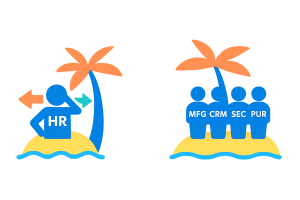
Creating isolated “data islands” inevitably leads to fragmentation between systems, departments, and the people who rely on them. It runs counter to the core principles of Human Capital Management, where collaboration, shared information, and unified processes are essential. When HR data lives outside D365, organisations frequently experience duplication, misalignment, and inefficiencies that undermine the very goals HR teams strive to achieve.
Choosing between D365 HR and a standalone HCM solution is ultimately your decision, but there are several well‑considered points worth reflecting on before making that call. Understanding how each option affects integration, data consistency, workflow automation, and long‑term ERP strategy will help ensure your HR processes support — rather than hinder — your wider Dynamics 365 environment.
Familiarity
A centralised Dynamics 365 ERP system with fully integrated HR functionality ensures the entire organisation becomes familiar with a single solution. Users benefit from a consistent look, feel, and method of navigation across all workstreams. In contrast, running two separate systems — each with its own interface, workflows, and productivity tools — inevitably leads to confusion and inconsistency within the workforce.
When different departments rely on different systems, “them and us” attitudes can quickly develop. This division is unhealthy in any workplace and often results in bias over which system represents the true source of information. In reality, there should only ever be one version of the truth when it comes to organisational data, and maintaining that principle becomes significantly harder when HR processes sit outside Dynamics 365.
Workflow
Workflow is one of the most important productivity tools in any modern business system. Many workflow activities follow reporting hierarchies, and to remain accurate and up to date, those hierarchies would need to be replicated in both systems if you choose a standalone HCM solution alongside Dynamics 365. That may sound straightforward, but in reality it is far more complex than it appears.
Developing functionality or building an interface to link two systems becomes particularly challenging when forward‑scheduled, date‑based data is involved — data that can and will be edited before it is actioned. We have attempted this ourselves and can honestly say we regretted the effort. It is expensive, requires extensive testing to cover real‑life scenarios, and even then remains fragile. Trying to maintain records manually as an alternative is error‑prone, admin‑heavy, and a thankless task for whoever is responsible.
Even Microsoft, with its vast investment resources, created a standalone HCM solution — Microsoft Talent. It introduced many new features and was positioned as an independent HCM product, separate from Dynamics 365 Finance & Operations. For customers seeking an all‑Microsoft stack, a sophisticated integration toolset was provided to connect the two.
However, despite all of Microsoft’s capabilities, the solution never fully delivered the seamless integration that had been envisioned. Ultimately, Microsoft made the sensible decision to bring HR back into Dynamics 365 as a suite of integrated HR modules.
The moral of the story is simple: if Microsoft itself struggled to perfect this model, is it really a sensible path for most businesses to pursue? Our view is that organisations should think very carefully before committing to a separate HCM system when robust, integrated HR functionality already exists within Dynamics 365.

Technical Ability
Because workflows often require logic and are semi‑technical in nature, the HR department will inevitably need its own administrator or specialist to manage them. Relying on a centralised IT support team to maintain the skills needed for yet another system is optimistic at best, and in reality you may find yourself needing a dedicated HR‑focused “techie” to keep a standalone HCM solution running smoothly.
This introduces a hidden long‑term cost that many organisations overlook when considering a two‑system strategy. Supporting multiple platforms demands additional expertise, ongoing training, and extra administrative effort — all of which erode the efficiency gains that HR teams are trying to achieve.

‘That Lot in HR’
If you do have your own solution its almost inevitable that you will be treated as ‘that lot in HR’ whenever there’s a difference or issue between the core business system and a separate HR solution, it’s human nature and a trait that professional HR personnel will recognise whenever there’s multiple systems and practises in play.
The wider business will never be as dynamically aware of the situation with regards to employees when two separate systems are involved. Creating interfaces to help alleviate this can be expensive and impractical as many might be required and trust in systems does not take long too break down as information silo’s form on either side.
Everyone pulls together better when all in the same boat and that’s why a fully integrated business solution incorporating HR and all your ERP processes really is the most efficient way of working together.
There should only be a single version of the truth within a business is the sensible view.
Duckling to Swan
When comparing D365 HR with a standalone HCM solution, it’s easy to assume that D365 HR looks a little plain out of the box. But the real value lies beyond the initial visual impression. The wider picture — the underlying functionality, configurability, and long‑term scalability — is where Dynamics 365 truly shines.
Dynamics is intentionally designed as a highly configurable product. It has to be, because Microsoft built it to be a long‑term ERP platform — much like any of their core back‑office products. The philosophy is simple: why change if you don’t need to? The tools Microsoft provides allow you to tailor the system to what matters most to your business. What you see as standard is only the starting point, not the finished article.
D365 Finance & Operations prioritises practicality. Beneath its straightforward interface lies genuine functional depth — not a superficial “beauty contest” façade, but a serious, long‑term business solution. When you use the tools available and invest in thoughtful configuration, the polished look will follow naturally, backed by the advantage of a superior, fully integrated ERP platform.
By contrast, the complexity, cost, and ongoing management required to integrate separate, distinct systems should never be underestimated. Choosing a fully integrated Dynamics 365 solution from the outset — and then using Microsoft’s powerful tools to present information in the way your business needs — will deliver the most cost‑effective and sustainable HR system in the long term.
Making the D365 HR vs standalone HCM decision based on appearance alone is a flawed strategy. Microsoft provides extensive configuration capabilities that allow you to shape your fully integrated D365 environment during implementation. With the right setup, that “duckling” becomes a “swan” — and you gain the long‑term benefits of a unified, scalable, and efficient ERP platform.
Additional Effort
When organisations choose to implement separate systems, every activity effectively doubles. Data migration, configuration, training, maintenance, documentation, support, and reporting all require their own dedicated resources. As these tasks multiply across two platforms, effort escalates rapidly — and so does cost.
The decision between D365 HR and a standalone HRM solution carries significant consequences. Opting for a separate HCM system introduces a long‑term operational burden that many businesses underestimate. Managing two systems demands more people, more time, more testing, and more coordination, turning what should be streamlined HR processes into an ongoing administrative challenge.
In contrast, a fully integrated Dynamics 365 HR approach consolidates effort, reduces duplication, and delivers a far more efficient and cost‑effective HR environment over the long term.
The Upgrade Path
When operating two separate systems, it’s important not to overlook the impact of ongoing updates and releases — especially in a SaaS (software‑as‑a‑service) environment where cloud‑based changes are frequent and continuous. Every update has the potential to affect interfaces, integrations, and even the processes that connect the systems, whether those processes are automated or manual.
Cloud technology has significantly reduced the traditional burden associated with upgrades, but adopting a two‑system strategy reintroduces complexity. Each release must be assessed for compatibility, potential disruption, and the risk of breaking integrations. What should be a straightforward update cycle becomes a recurring consideration point, adding effort, cost, and uncertainty to your HR and ERP landscape.
A fully integrated Dynamics 365 HR approach avoids these challenges, ensuring that updates flow through a single, unified platform without the overhead of maintaining and synchronising multiple systems.
The Bolt On Approach
As you would expect from a Microsoft product, Dynamics 365 leads the way in terms of connectivity — and this is where specialist applications from other software providers can be a sensible consideration. Integrating a third‑party tool that performs a specific function better than native D365 functionality should never be seen as a barrier, particularly when that function represents only a small part of your overall HR requirements.
A common example in the retail and leisure sectors is workforce and shift planning. Dynamics 365, with its strong manufacturing heritage, can plan production around workers, skills, shift patterns, machine capacity, and routing. But configuring production functionality for a non‑production organisation is impractical. In these cases, purchasing a specialist people‑planning tool and interfacing it with D365 simply makes sense. There is work involved, but the logic is sound.
However, organisations — especially those with scale — must be cautious not to get the decision the wrong way around. Buying a standalone solution because it excels at one particular feature does not mean it will match Dynamics 365 Finance & Operations across the rest of your HR or ERP needs. A bolt‑on should complement D365, not replace core functionality that Dynamics already delivers at enterprise level.
The key is balance: use D365 as the fully integrated foundation, and bolt on specialist tools only where they genuinely add value without undermining the strength, consistency, and long‑term sustainability of your ERP environment.
MS Vertical Partner Approach
Within the Dynamics HR ecosystem, a small number of specialist partners have taken the core Dynamics 365 Finance & Operations HR functionality and continually enhanced it. One of the most notable — and referenced elsewhere on our website — is Fourvision. They are a long‑standing Microsoft partner we have worked both alongside and opposite on multiple implementations, and over the years they have consistently expanded and strengthened Dynamics HR capabilities.
AX Software formalised a closer partnership with Fourvision in 2026 when we became implementation and reseller partners for their latest iteration of Fourvision Advanced HRM. We had long recognised that the features and functions they developed removed much of the programme and project management burden we repeatedly encountered with more demanding HR clients. Rather than building and maintaining custom software — especially given the rapid pace of technical change — we prefer to de‑risk projects by adopting a well‑considered, tried, tested, and robust out‑of‑the‑box solution. For customers whose requirements exceed standard D365 F&O capabilities, reviewing Fourvision’s offering is strongly recommended.
Fourvision have created seamless add‑ons (the term “bolt‑on” doesn’t do them justice) that fully conform to Microsoft standards. The look, feel, and user experience mirror standard D365 F&O so closely that, in practice, you are simply activating additional functionality in the same way you would enable Microsoft’s own modules. Their 2026 release of Advanced HRM (AHRM) represents another significant step forward in capability — a release we were very pleased to see arrive.
Vertical products like Advanced HRM not only bridge functional gaps but also present HR data in formats that forward‑thinking HR professionals expect from leading HCM solutions. Seeing these capabilities within an ERP platform elevates Dynamics 365 F&O to another level. As such, Advanced HRM should be seriously considered if your HR team has a demanding requirements list or if you are adopting an HR‑first deployment strategy, as it offers clear near‑term budgetary and implementation advantages.
Fourvision also have strong historical ties with Microsoft, having previously sold functionality that later became part of standard D365 F&O. Their integration approach is exceptionally tight — they have invested heavily in replicating data entity structures so that the two systems blend seamlessly when deployed. For end users, there is nothing to suggest they are working across different software platforms.
To read more about Fourvision’s Advanced HRM suite of modules and how AX Software can help deliver them, click here.